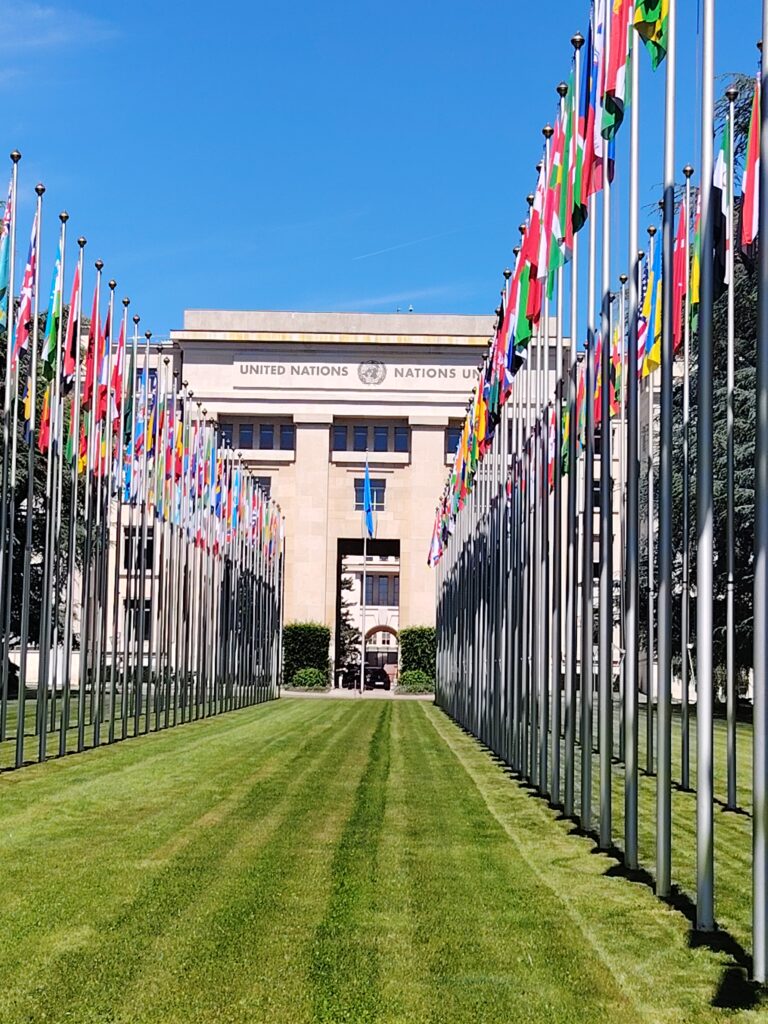
(United Nations Headquarters in Geneva, Switzerland. Palais des nations à Genève, Suisse. 2026)
The United Nations and the Importance of French-English Interpretation
The United Nations (UN) brings together countries with different languages, political systems and cultural traditions to address some of the world’s most pressing challenges. French and English are two of its six official languages and its two working languages of the Secretariat. Professional interpretation enables diplomats and delegates to communicate accurately during negotiations on international security, human rights, climate change, migration, trade and humanitarian assistance.
French-speaking countries such as France, Canada, Belgium, Switzerland and Senegal work alongside English-speaking countries including the United States, the United Kingdom, Ireland, Australia and Ghana. These relationships extend beyond the United Nations to diplomatic missions, international organizations, government meetings and bilateral negotiations.
In each setting, French-English interpreters do more than convert words between their languages. They preserve meaning, tone and nuance, helping participants understand complex arguments, cultural differences and diplomatic intentions. Accurate interpretation is essential when discussing sensitive matters such as international conflicts, immigration policy, criminal justice and economic cooperation.
How Does Simultaneous French-English Interpretation Work?
At international conferences, interpreters typically work in sound-insulated booths equipped with microphones, headphones and interpreter consoles. They listen to a speaker through headphones and interpret into another language almost simultaneously. Their voices are transmitted to participants through receivers and headsets, allowing delegates to follow proceedings in their preferred language.
Interpreters generally work in pairs or teams, alternating to maintain concentration and accuracy. Consecutive interpretation, in which the speaker pauses while the interpreter delivers the message, is another option for smaller meetings, depositions and legal interviews.
The appropriate interpreting method depends on the event, audience, technical requirements and confidentiality needs.
Origins of Modern Simultaneous Interpreting
The history of modern simultaneous interpretation is closely connected to the Nuremberg Trials of 1945–1946. The International Military Tribunal conducted proceedings in English, French, German and Russian, requiring a practical way for judges, lawyers, defendants and witnesses to understand one another.
IBM supplied interpreting equipment based on the earlier Filene-Finlay system. Using microphones, switching equipment and headphones, the system transmitted speeches and their interpretations through separate language channels. This allowed multilingual proceedings to move forward without the lengthy pauses required for consecutive interpretation.
The success of the system helped establish simultaneous interpreting as a standard feature of major international conferences. The United Nations subsequently adopted the method, transforming communication in multilateral diplomacy.
FRQCA Your French-English Interpreters!
FRQCA provides French-English and English-French translation and interpreting services for legal professionals, businesses and organizations. From depositions and legal proceedings to international meetings and business negotiations, professional interpretation helps ensure that language differences do not become barriers to understanding.
Contact FRQCA to discuss your French-English interpretation requirements and arrange professional language services for your next legal proceeding, conference or international meeting.